John already told us why he wrote his book, and drew it to a close, at the end of chapter 20. Chapter 21 is a coda — an epilogue added because there was one more thing that had to be told. If chapter 20 answered the great question of the whole Gospel, who is Jesus?, chapter 21 answers the question every failure quietly carries afterward: is there a way back for me? Peter, who swore he would die for Jesus and then denied him at a fireside, needs an answer to that. And so, remarkably, does the risen Christ arrange a fire, and a breakfast, and three gentle questions, to give it to him.
1“It is the Lord!”
Back in Galilee, at loose ends, Peter announces, "I am going fishing," and the others go with him. There may be a whiff of retreat in it: back to the old boats and the old trade, the life before the call. And it goes exactly as it went the first time Jesus met them: they fish all night and catch nothing. Then a figure on the shore in the grey dawn calls out.
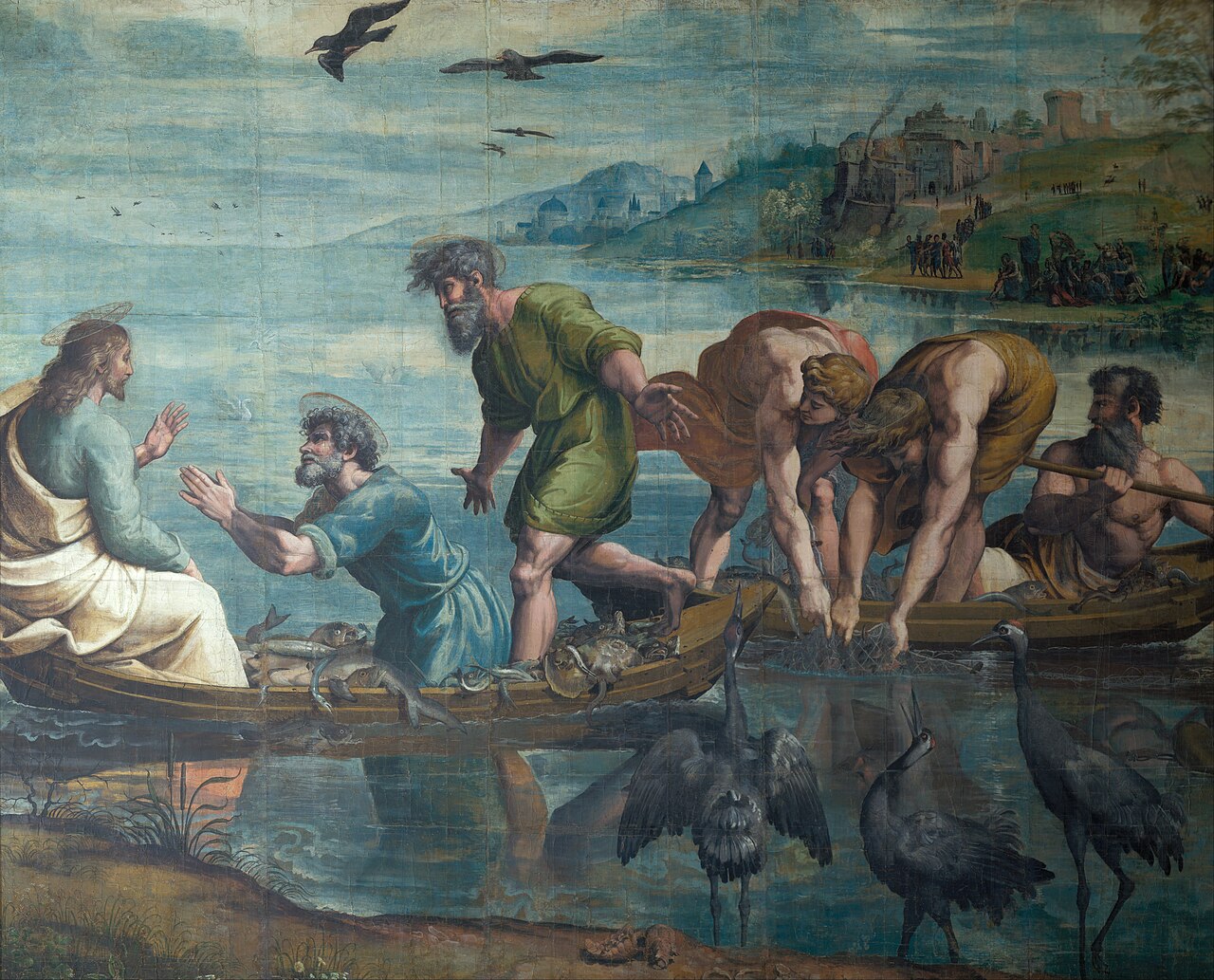
The empty night and the sudden, overwhelming catch tell the beloved disciple everything: "It is the Lord!" And Peter — impulsive, whole-hearted Peter — does not wait for the boat. He throws himself into the water to get to Jesus faster. They drag the net ashore, and John, ever the eyewitness, records the exact tally: a hundred and fifty-three large fish, and the net not torn. People have counted symbolic meanings in that number for two thousand years; John may simply be remembering, with a fisherman's precision, an unforgettable morning. What waits for them on the beach is the tenderest scene imaginable.
The risen Lord of the universe, who a chapter ago walked through locked doors and received the worship "my Lord and my God," is on his knees at a fire cooking breakfast for tired, wet men. He does not need their fish; he already has fish on the coals. He simply wants to feed them. There is something almost unbearably gentle about a resurrection that expresses itself as a hot meal at daybreak. This is the same glory we saw at Cana and on the hillside — a glory that loves to provide, that shows up in ordinary kindness. The God of the empty tomb makes breakfast.
2“Do you love me?”
Then the heart of the chapter, one of the most healing conversations ever recorded. It happens over that charcoal fire — and John uses the same rare word for it that he used for the fire in the high priest's courtyard, where Peter warmed his hands and denied his Lord three times (18:18). Jesus has built a fire deliberately like the one where Peter fell, and over it he asks three questions to answer the three denials.
Three denials, three questions, three commissions. Peter is "grieved" that Jesus asks a third time, because the third question presses on the exact spot of the third denial, but the grief is the point. Jesus is not rubbing his nose in the failure. He is healing it, denial by denial, letting Peter say "I love you" as many times as he once said "I do not know him." And notice what restoration looks like: not a lecture or a probation, but a recommission. "Feed my lambs… tend my sheep… feed my sheep." The proof and shape of Peter's restored love will be that he cares for the flock of the Good Shepherd. The one who failed is not benched. He is handed the sheep. That is how Jesus mends people: he forgives them and then trusts them with something.
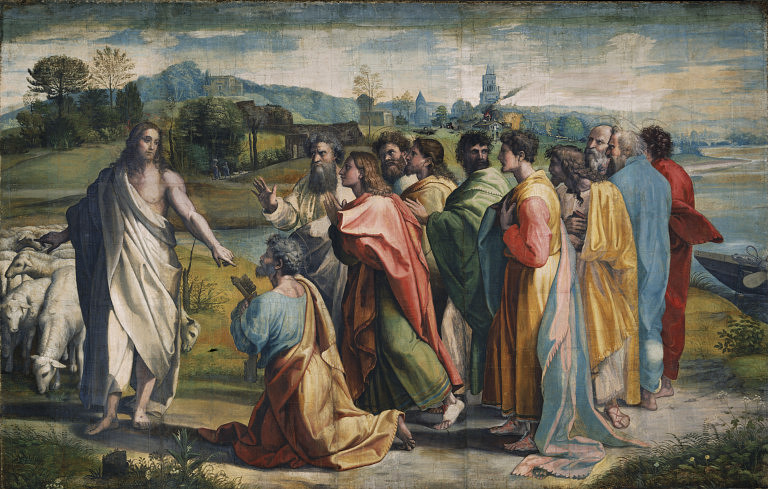
Then Jesus tells Peter, in veiled words, that he will one day die for him after all — stretching out his hands, led where he would not choose, glorifying God by his death (21:18–19). The denial did not disqualify him; he would get to lay down his life for his Lord in the end. And the whole exchange closes on the two words that began it three years earlier by this same sea: "Follow me." The call that first drew a fisherman from his nets is the call that puts him back on his feet after his worst failure. Everything comes round to those two words.
3“You follow me”
Peter, being Peter, immediately glances at the beloved disciple and asks, "Lord, what about this man?" — comparing, the way we all do. Jesus' answer is a gentle rebuke and a piece of freedom for every disciple since: "If it is my will that he remain… what is that to you? You follow me!" (21:22). Your calling is not your neighbor's calling. Stop measuring your path against theirs; keep your eyes on Christ and follow the road he gives you. Then the author steps forward, for the first and only time, to sign his work.
The anonymous "disciple whom Jesus loved," who has slipped through the whole Gospel without giving his name, at the supper, at the cross, at the empty tomb, is the one who wrote it, and he was there. This is not secondhand legend; it is testimony, from a man who leaned on Jesus' chest and watched him die and ate the breakfast he cooked. And the very last verse lays down the pen with a kind of holy shrug, an eyewitness overwhelmed by his subject.
Were every one of them to be written, I suppose that the world itself could not contain the books that would be written.
John 21:25He has told us seven signs and one long last week, and he knows he has barely begun. There is not enough shelf space in the world for all that Jesus is and did. The book ends, but the subject does not.
Where the whole walk leaves us
From "the Word was God" to "follow me"
We began this study before the beginning of the world, with a sentence of pure altitude: "In the beginning was the Word, and the Word was with God, and the Word was God." We end it on a beach at dawn, with the same Word made flesh crouched over a fire, cooking fish for men who let him down, asking a broken friend three times if he loves him. That is the astonishing arc of this Gospel — from the highest possible claim about who Jesus is, all the way down to the most intimate possible picture of what he is like. The One who made everything makes breakfast. The eternal God calls a coward by his failures and hands him the sheep. And to Peter, and to the beloved disciple, and to every reader who has walked these twenty-one chapters, the risen Christ says the same two words he has been saying from the start: Follow me.
John wrote it all down for one reason — "that you may believe that Jesus is the Christ, the Son of God, and that by believing you may have life in his name." That invitation is still open. The Lamb still takes away sin; the light still shines in the darkness; the tomb is still empty; and the risen Christ still knows your name.
Questions
- The risen Lord expressed his glory by cooking breakfast. Where do you tend to look for God in the dramatic and miss him in the ordinary and kind? Reflect
- Jesus healed Peter's three denials with three questions over a charcoal fire. Is there a failure you assume disqualifies you that Jesus may want to restore — and then use? Reflect
- Restoration for Peter meant being handed the sheep, not put on probation. How does that reshape your idea of how God deals with those who fail him? Discuss
- "What about this man?" "What is that to you? You follow me." Whose path do you keep comparing yours to, and how would it free you to fix your eyes on Christ instead? Reflect
- Having walked the whole Gospel from "the Word was God" to "follow me," what has changed in how you see Jesus — and what is your answer to his two-word invitation? Discuss