Most stories begin with a birth. John begins before there was anything to be born into. Matthew traces a family tree, and Luke opens in the temple with an old priest. John goes back further, past the first day of creation, to a figure who was already there when the beginning began. He does not name him at first. For thirteen verses he just calls him the Word. He lets that title build before he tells us it belongs to a man from Nazareth, one who could be touched and heard and, in the end, killed.
These eighteen verses work like an overture. They sound the themes the rest of the book will develop: life and light, witness and belief, glory, grace, and truth. They also name the hard part of the story, that the world would not know its own Maker, and the surprise that some received him anyway. Read the Prologue slowly and you are holding the whole Gospel in miniature. Everything after it fills this in.
1In the beginning
The first three words are a quotation, and every Jewish reader would have caught it. "In the beginning" is how the Bible itself begins. John is opening his Gospel with the opening of Genesis on purpose, because he is about to tell a creation story of his own. But watch the difference. Genesis says, "In the beginning God created." John says, "In the beginning was the Word." When the beginning began, the Word already existed. He did not start at the starting line. He was already there, before creation, with no beginning of his own.
Then, in three short clauses, John says three things about this Word. They seem impossible to hold together, and he means all three at once.
The Word was in the beginning
He is eternal. Before the first atom, before time had a first moment, the Word already existed. Whatever else he is, he is not a creature.
The Word was with God
He is distinct. The Greek says he was pros ton theon, face to face with God, close beside him. The Word is not just one side of God. He is a person, turned toward God.
And the Word was God
He is fully divine. Not a lesser god, not God's first and finest creation, but God himself. John has just set the Word apart from God, and now he turns and says the Word is God, without flinching.
Hold those together and you are at the source of what the church later called the Trinity. The Word is with God, and the Word is God. John is not giving us that doctrine in technical language here. That language came later, built to protect what he says in this one line. His job in verse 1 is simpler. He wants the eternal deity of the Word settled in your mind before the story starts. Then, when this Word later weeps and bleeds, you never forget who is doing it.
λóγοςlogos · "word, reason, speech"
John picked a word already loaded from two directions. To Greek ears, logos meant the reason that holds the universe together, the logic behind everything. To anyone raised on the Hebrew Scriptures, "the word of the Lord" was how God got things done. He spoke, and the world came to be (Genesis 1). "By the word of the Lord the heavens were made" (Psalm 33:6). God's word was his power reaching into the world to create, reveal, and save. John takes all of that meaning and lays it on a person. The reason behind the universe and the voice that made it turn out to be Someone you can meet.
The New Testament keeps circling back to this same claim about who Christ was before Bethlehem. When you have a moment, read these side by side and watch the picture converge:
2Life, and the light of men
If verse 1 tells us who the Word is, verse 3 tells us what he has done, and it closes off any middle position. "All things were made through him, and without him was not any thing made that was made." Everything that exists is either the Word or was made through the Word. There is no third category. He is on the Creator's side of the line that divides God from everything else, because everything on the other side came to be through him. A creature cannot create every creature. So the Word is not one of them.
And in him, John says, was life, and that life "was the light of men." These two words, life and light, are about to become two of the most important in the Gospel, and here they arrive quietly. Life is not just biological existence. In John it is the very life of God, the thing Jesus came to give "abundantly" (10:10) and the thing the whole book is written to produce in its readers (20:31). Light is what that life looks like when it reaches us: truth, and the ability to finally see. Where the Word is, people can see.
Then verse 5, and the tone shifts. Up to now the Prologue has been calm, hovering above creation. Suddenly there is darkness, and a fight. "The light shines in the darkness, and the darkness has not overcome it." In one line John introduces the drama of the whole Gospel, and really of the whole Bible. There is a darkness. It hates the light. It will do everything it can to put the light out, and at the cross it will look, for one long Friday, like it finally has. But John writes in the present tense. The light still shines. The darkness threw everything it had at it, and the light is still burning.
καταλαμβáνωkatalambanō · "to overcome" or "to grasp, comprehend"
The verb behind "overcome" in verse 5 has a deliberate double meaning, which is why the ESV footnotes the other option, "the darkness has not understood it." Both are true, and John may mean both. The darkness could not seize the light to put it out, and it could not grasp the light to understand it. The world it entered did not get what it was looking at. That failure to understand runs through the whole Gospel: Nicodemus confused in the dark, the crowds arguing, the officials plotting, all of them staring at the light and seeing nothing.
Light and darkness become a running language in John and in his letters. Trace how the metaphor develops once Jesus picks it up and applies it to himself:
| Theme | Genesis 1 | John 1 |
|---|---|---|
| The beginning | "In the beginning, God…" (1:1) | "In the beginning was the Word…" (1:1) |
| Creation by word | "And God said… and it was so" | "All things were made through him" (1:3) |
| Light in darkness | "Let there be light" (1:3) | "The light shines in the darkness" (1:5) |
| Life | The breath of life, living creatures (1–2) | "In him was life" (1:4) |
The parallel is not for decoration. John is telling us that the coming of Jesus is a new creation, a fresh "let there be light" spoken over a world gone dark. What God started in Genesis he is starting again, and this time the light has a face.
3A man named John
The change of altitude is jarring, and it is meant to be. One verse we are among the eternal relations of God. The next we are told, plainly, "There was a man." The Greek even changes its verb. The Word was, a state with no beginning, but this man came to be, born like the rest of us. His name was John. Not the author, but John the Baptist, the last of the old prophets, sent to stand at the turning of the ages and point.
And that is all he is here: a pointer. Three times in two verses the text presses the word witness, and just as firmly it keeps John out of the role that is not his. "He was not the light." In a Gospel where so many people grab at the wrong thing, the crowds wanting a king, the officials guarding their power, here is a man who knew exactly what he was and what he was not. His greatness was aiming attention away from himself. He is the friend of the bridegroom, glad just to hear the bridegroom's voice (3:29), content to grow smaller.
"Witness" is a courtroom word, and it may be the key image of this Gospel. The whole book is built like a trial. The evidence for Jesus is called and weighed: the Baptist, the Scriptures, the works Jesus does, the Father, and finally the eyewitnesses, one of whom is the author (19:35; 21:24). The reader sits in the jury box. By the end you will be asked, like everyone in the story, to reach a verdict on who this man is.
4His own did not receive him
Now the tragedy that verse 5 hinted at is stated outright, and it lands in three widening circles. The Word came into the world, and the world, though it was made through him, did not even recognize him. He came to his own, the covenant people who had waited centuries for exactly this, and they did not take him in. The Maker knocked on the door of his own house, and the tenants turned him away. There is no colder line in the New Testament than "his own people did not receive him."
And then, against that dark background, verse 12 lights up. "But to all who did receive him… he gave the right to become children of God." Not the deserving or the well-born or the religious insiders, but all who received him, whoever they were. To believe in his name, in John's language, is not to run an idea through your head. It is to hand yourself over to the person. And to those who do, he gives what no bloodline could ever give: the right to be born into the family of God.
Verse 13 guards that gift. This new birth is "not of blood," so you cannot inherit it from believing parents. It is "nor of the will of the flesh," so no appetite of ours produces it. It is "nor of the will of man," so no decision, however sincere, manufactures it. It is "of God." The move is entirely his. We will meet this again a few chapters later, on a rooftop at night, when a respected, learned man is told he must be born again (3:3–8). The Prologue already tells us the thing Nicodemus cannot work out. A child of God is not made. He is born, from above, of God.
The "right to become children of God" opens a door John loves to walk through. See where the new birth and the family of God lead:
5The Word became flesh
Everything the Prologue has built now turns on one sentence, maybe the most consequential sentence ever written.
The eternal Word, the one who was God and made all things, became flesh. John does not soften it. He does not say the Word took on a fine appearance, or put on a body the way you put on a coat. He uses the bluntest, most physical word he had: sarx, flesh, the stuff of skin and blood and hunger and death. And he says the Word became it. Whatever we cannot understand about how, John will not let us dodge the plain fact. The One no one had ever seen now had a face. He got tired. He wept at a grave. He could be held, and he could be nailed down. This is the center of the Christian faith, and the thing the world has never gotten over: that God did not stay safely infinite but came to us, as one of us, in a body that could be killed.
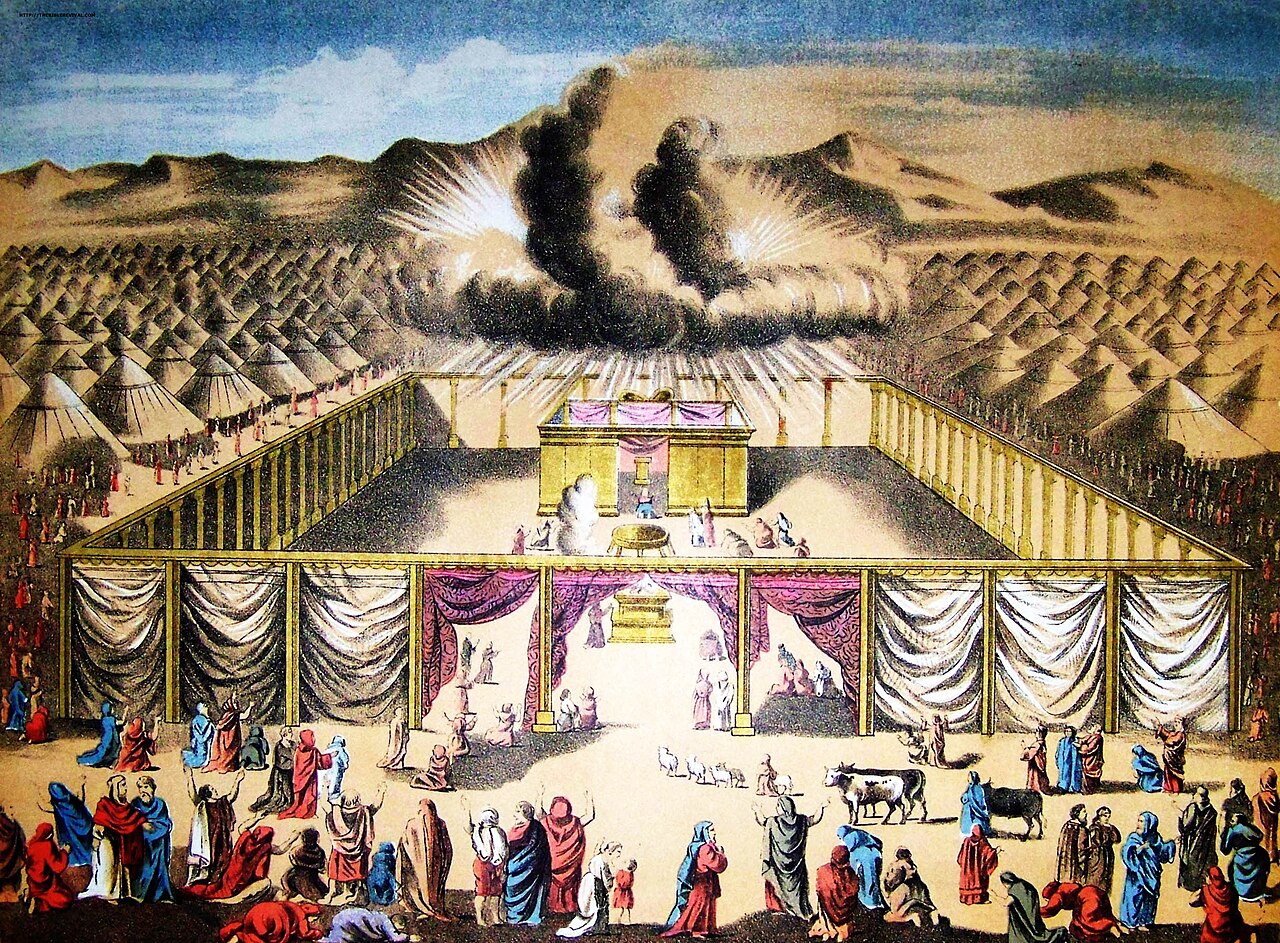
Then a quieter word, easy to read past, that would have made a Jewish reader sit up. He "dwelt among us." The verb is eskēnōsen, and it means he pitched his tent, he tabernacled among us. In the wilderness God had come down to live in a tent in the middle of his people, and his glory filled it so thickly that Moses could not go in (Exodus 40:34–35). John is reaching straight back to that tent. The place where God comes to live with his people is no longer a tent of goatskin or a temple of stone. It is a human life. And "we have seen his glory." The glory that once burned inside the tabernacle now walked around Galilee, in plain sight, in the person of Jesus.
σκηνóωskēnoō · "to pitch a tent, to tabernacle"
The noun form, skēnē, is the ordinary Greek word for the tabernacle in the Greek Old Testament. Some have even heard, underneath the Greek, an echo of the Hebrew shekinah, the visible dwelling-presence of God with Israel. Either way, John's meaning is clear. The God who camped among his people at Sinai has moved in again, this time for good, in flesh. Watch him make it explicit in the next chapter, when Jesus points to his own body and calls it the temple (2:19–21).
The verse ends with a phrase that points back a thousand years: the glory we saw was "full of grace and truth." When Moses begged on the mountain to see God's glory, the Lord passed by and announced his name: "The Lord, the Lord, a God merciful and gracious… abounding in steadfast love and faithfulness" (Exodus 34:6). Grace and truth. Steadfast love and faithfulness. John takes the two words at the very heart of what God revealed to Moses and says we have now seen them, in full, in a person. What Moses caught in a glimpse from the cleft of a rock, John and the others watched up close, day after day.
Moses asks to see God's glory
He is hidden in the rock; God's glory passes by; no one may see God's face and live. God proclaims himself "abounding in steadfast love and faithfulness."
We have seen his glory
The glory once veiled is now beheld in the Word made flesh, "full of grace and truth" — the very words of Exodus 34, fulfilled in a person you could look in the eye.
And the Word became flesh and dwelt among us, and we have seen his glory.
John 1:146Grace upon grace
The Baptist's voice breaks in again, and his riddle is pure Prologue: "He who comes after me ranks before me, because he was before me." John the Baptist was born first, six months ahead of Jesus. Yet the one who came after him existed before him, because, as verse 1 already told us, the Word had no beginning. The cousin who arrived later was there at the creation of the world. Even the Baptist's paradox points back to the eternity John opened with.
Then verse 16, one of the loveliest phrases in Scripture: "from his fullness we have all received, grace upon grace." The Word is not a reservoir that can run low. He is fullness itself. Out of that fullness he pours grace, and then more grace on top of it, wave after wave, one kindness arriving before the last has landed. This is what it is like to live off of Christ. Not one deposit of grace long ago, but a steady current of it, renewed faster than you can spend it.
Verse 17 gets badly misread by people eager to set the Old Testament against the New. "The law was given through Moses; grace and truth came through Jesus Christ." Read carelessly, that sounds like law equals bad, grace equals good, and Moses can be dropped. But John has just spent verse 14 wrapping Jesus in the language of Moses' own meeting with God. The law was itself a gift, a real grace. The point is not opposition. It is escalation. What came through Moses was real and good and preparatory. What came through Jesus is the fullness those earlier gifts were pointing toward. It is grace giving way to greater grace. And notice: only here, in verse 17, after seventeen verses about "the Word," does John finally write the name. Jesus Christ. The overture lands on a single, real, nameable man.
7He has made him known
The Prologue closes where it opened, on God, framing the whole passage in one thought. "No one has ever seen God." That was the hard limit of the old covenant. Even Moses, the friend of God, was told, "you cannot see my face, for man shall not see me and live" (Exodus 33:20). The infinite God is beyond our sight, past the reach of the most spiritual person who ever lived. Every attempt to look straight into the being of God ends at the same wall.
And then, over that wall, the answer: "the only God, who is at the Father's side, he has made him known." The God we cannot see has not left us guessing. The Son has always been "at the Father's side," as close as possible, resting against the Father's chest. Now he has come out from that nearness and shown us what God is like. The verb John uses is exēgēsato: he has explained him, unfolded him, told him out. It is the word we get exegesis from. Jesus is the exegesis of God. If you want to know what the invisible God is like, you do not climb. You look at Jesus, and you are looking at the heart of God put into a life you can follow.
You may find that older translations read "the only Son" in verse 18 rather than "the only God." The difference goes back to the manuscripts. Our earliest and best copies read monogenēs theos, "the only God" (or "God the only Son"), and that is the reading the ESV follows. It makes a fitting bookend. The Prologue that began "the Word was God" ends by calling the Son "the only God" who makes the Father known. Either way the sense holds, but the stronger reading only sharpens the point John has made from verse 1.
The overture, and the story it opens
What the Prologue hands you
John has told you the ending before the story starts, and he did it on purpose. From here on you will watch Jesus get hungry, argue with religious leaders, dodge stones, and finally hang on a Roman cross. The temptation, every step of the way, will be to see only a man. A remarkable one, but only a man. The Prologue is John's refusal to let you make that mistake. Before the first miracle, before the first line of dialogue, he has set a truth over the whole book that nothing in the story can knock down. This is the eternal Word, the Maker of everything, God himself, living among us in flesh.
So when his own people turn on him, you will remember verse 11 warned you. When the darkness closes in around a hill outside Jerusalem, you will remember verse 5 already told you how that fight ends. And when he says, as he will, "whoever has seen me has seen the Father" (14:9), you will hear verse 18 coming back. The rest of the Gospel is the slow, patient proof of what the Prologue claims. As we walk through it, our job is to keep receiving him, grace upon grace, and to let the light do what light does. Help us finally see.
Questions
- John deliberately begins with the same words as Genesis. What is he claiming by telling the coming of Jesus as a new creation story? Discuss
- Verse 1 says the Word was with God and was God in the same breath. Why does it matter, for the rest of the Gospel, that both are held together rather than one dropped? Discuss
- The Baptist's whole greatness was knowing what he was not. Where is it hardest for you to point away from yourself toward Christ? Reflect
- Verse 13 says children of God are born "not of… the will of man, but of God." How does it change the way you hold your faith to know the new birth was God's initiative and not your achievement? Reflect
- "We have seen his glory." John claims the glory Moses only glimpsed was walked out in full in a human life. If Jesus is the "exegesis" of God, what does looking at him teach you about God that you would not have guessed on your own? Discuss