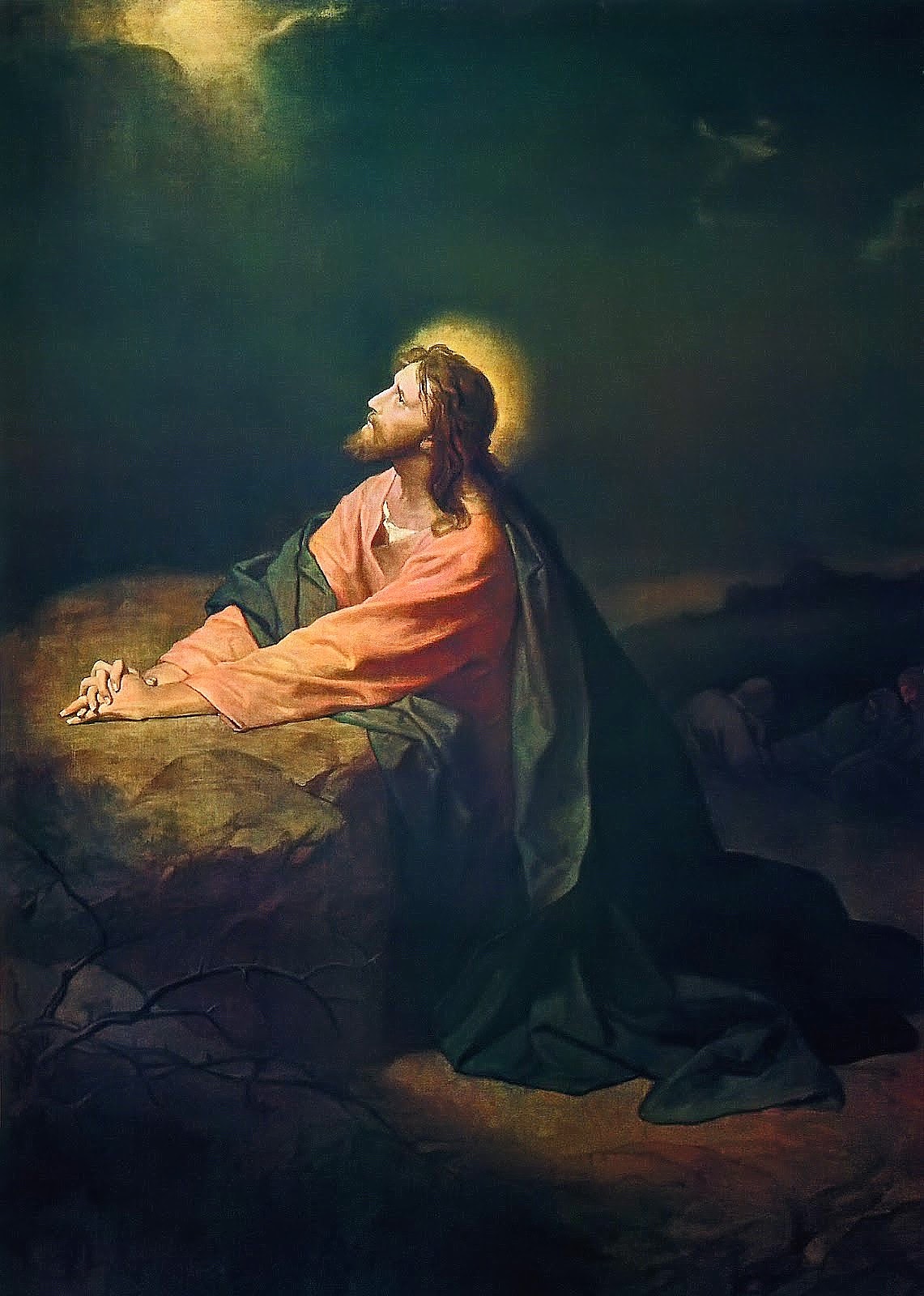
For four chapters Jesus has been speaking to the disciples. Now, in front of them, he lifts his eyes and speaks to his Father, and we are allowed to overhear it. This is the longest recorded prayer of Jesus in the Gospels, and the church has long called it the High Priestly Prayer. Here, on the threshold of the sacrifice, our great high priest does what a high priest does: he intercedes for the people before he offers the blood. It moves in three widening circles. He prays first for himself, then for the eleven men in the room, and then, remarkably, for everyone who would ever come to believe through their message. If you are a Christian, you are in this prayer. On the last night of his life, Jesus was praying for you.
1“Father, the hour has come”
He opens where the whole Gospel has been heading: "the hour has come." And his first request is not to be spared it but to be glorified through it — because in John the cross is the throne, and the darkest hour is the shining of his glory. Along the way he drops a definition of eternal life so simple it is easy to rush past: "this is eternal life, that they know you." Not merely to know about God, and not first a length of time (living forever), but a relationship — to know God, personally, as the Son knows the Father. Eternal life, on Jesus' own lips, is less a destination than an acquaintance that death cannot end. Then he asks for something no mere creature could ask.
"The glory that I had with you before the world existed." We are back at the Prologue: "In the beginning was the Word, and the Word was with God" (1:1). Jesus prays as one who remembers a glory older than creation, shared with the Father before there was a universe to be glorified in. He is asking to step back into a splendor he laid aside to become flesh — and he asks for it by way of the cross. This is no ordinary man saying his prayers. It is the eternal Son speaking to his Father in the intimacy they have always known.
2The prayer for his own
The second circle widens to the eleven. And what he asks for them tells us what he most wants for his people in a hostile world. Not comfort or success, but that they be kept, made one, and made holy.
Notice what he does not pray. He does not ask the Father to lift his disciples out of the world and its trouble — "I do not ask that you take them out of the world." He means to leave them in it, as light in the dark, as branches bearing fruit where it is hard to grow. What he asks instead is that they be kept — guarded from the evil one — and sanctified, made holy, set apart by the truth of God's word. The safety Jesus prays for his people is not escape from the world but protection within it. And the tool of their holiness is named plainly: "your word is truth." We are made clean and set apart not by our striving but by the truth of God working on us.
3The prayer that reaches us
Here the prayer leaps across the centuries. "Those who will believe in me through their word" means the whole church that would grow from the apostles' testimony, which is to say, us. The Gospel of John is itself part of "their word," the message through which we came to faith. So the moment you believed, you stepped into a request Jesus made out loud on the night before he died. He was not only thinking of the eleven. He was thinking of you, and he asked the Father to make you one with his people and to keep you.
And the thing he asks for us, over and over, is oneness — "that they may all be one, just as you, Father, are in me, and I in you." The unity he prays for is modeled on the unity of the Trinity itself, and it has a missionary purpose: "so that the world may believe." The love and unity of Christians is meant to be evidence to a watching world that the Father sent the Son. Our divisions are not a minor embarrassment; they are a contradiction of this prayer. He ends by asking the highest thing of all — that we would be with him to see his glory, and that "the love with which you have loved me may be in them" (17:24, 26). The Son asks that the very love the Father has for him would come to live in us. That is the last thing he prays before he walks out to be arrested.
Where this leaves us
Prayed for by name
There is a peculiar comfort in John 17 that no other chapter gives quite so directly. We are used to being told to pray to Jesus. Here we get to listen as Jesus prays for us — not the disciples only, but "those who will believe through their word," which is our name in the prayer. And the prayer did not stop that night. The letter to the Hebrews says he "always lives to make intercession" for his people; the same voice that lifted these petitions on the eve of the cross is lifting them still. Whatever you are carrying, you are being prayed for by the one person whose prayers the Father always hears. He asked that you would be kept, made holy, made one with his people, brought at last to be with him and to see his glory, and filled with the very love the Father has for the Son. On the hardest night of his life, that is what he wanted for you. It is worth asking whether we want the same things for ourselves that Jesus asked for us.
Questions
- Jesus defines eternal life as knowing God, not merely living forever. How does that reframe what you are actually being offered in the gospel? Reflect
- He prayed not that his people be taken out of the world but kept in it. Where are you praying for escape when God may intend to keep and use you right where you are? Discuss
- "Those who will believe through their word" includes you. What does it stir in you to know Jesus prayed for you by name the night before he died? Reflect
- He prays for a unity that would make the world believe. How seriously do we take Christian disunity in light of this prayer? Discuss
- His final request is that the Father's love for him would live in us. Do you actually believe you are loved with that love — and how would it change you if you did? Discuss