There is a stillness over John's account of the cross. He spares us the loud despair the other Gospels record; he never quotes the cry "why have you forsaken me?" What he gives instead is a Jesus who is composed and sovereign to the end. He arranges care for his mother, fulfills Scripture point by point, and dies not with a defeated whimper but with a shout of completion. And running through the whole scene is a deep, deliberate irony that John clearly enjoys: at every turn people mean to mock Jesus' kingship, and at every turn they accidentally proclaim it. The crown of thorns, the placard, the taunt "Behold your King": every bit of it is truer than the speakers know. This is a coronation disguised as an execution.
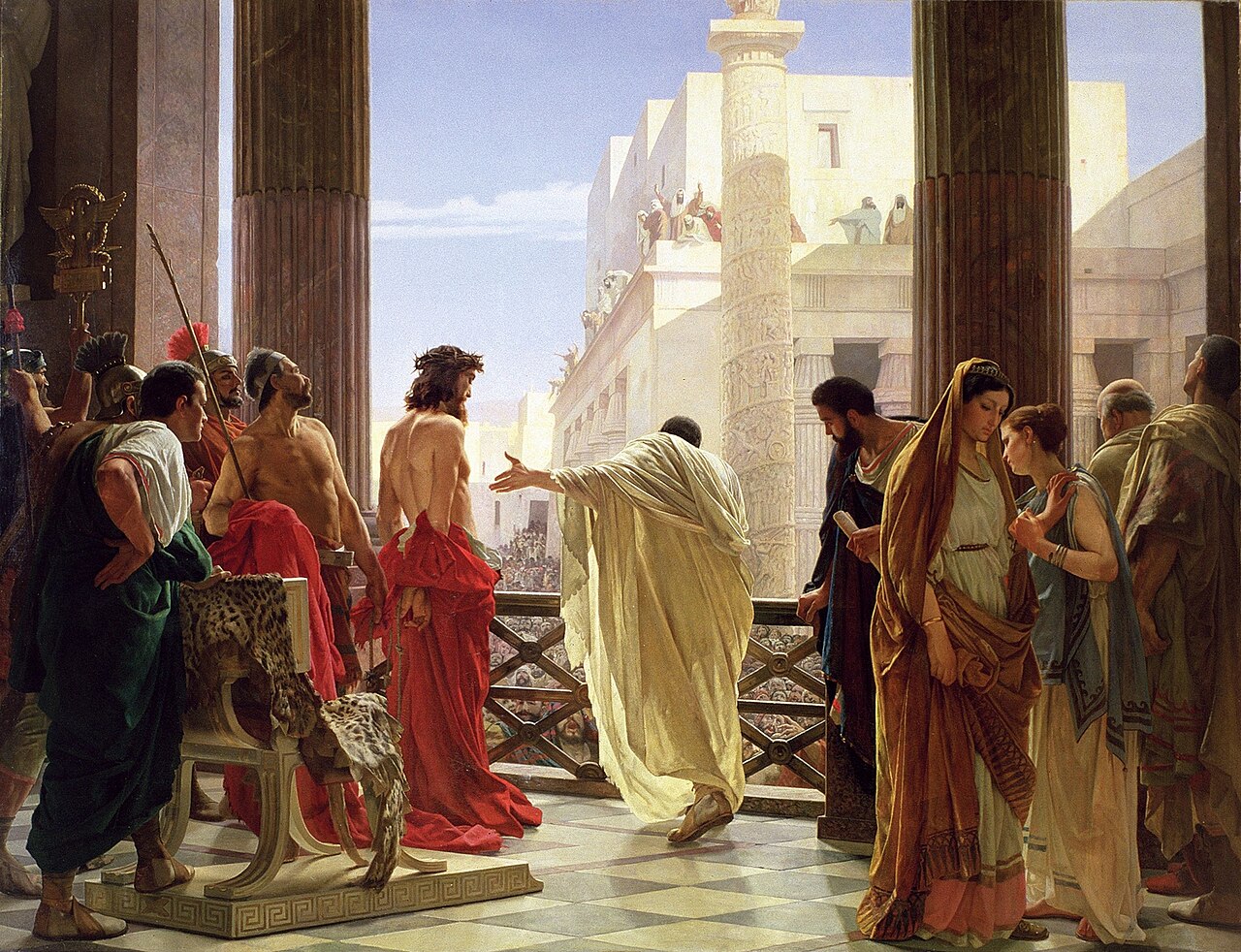
1“Behold the man!”
Pilate has Jesus flogged, and the soldiers dress up their cruelty as a joke: a crown twisted from thorns, a purple robe, a mocking "Hail, King of the Jews!" Then Pilate brings the beaten, bleeding figure out before the crowd with a line that has echoed down the centuries.
Pilate means it with contempt or pity: look at this pathetic figure, is this the threat you're afraid of? But John lets the words ring with a meaning Pilate cannot hear. Behold the man: the true human being, the Word made flesh (1:14), the second Adam, the one human who bears the image of God unbroken, standing crowned and robed in the very moment he is most despised. When the crowd bays for crucifixion and Pilate tries once more, "Behold your King!", they answer with the most tragic sentence in the Gospel: "We have no king but Caesar" (19:15). The chief priests, whose whole existence testified that God alone was Israel's king, renounce him for the emperor. To be rid of Jesus, they deny the hope of their own nation.
2The King on the cross
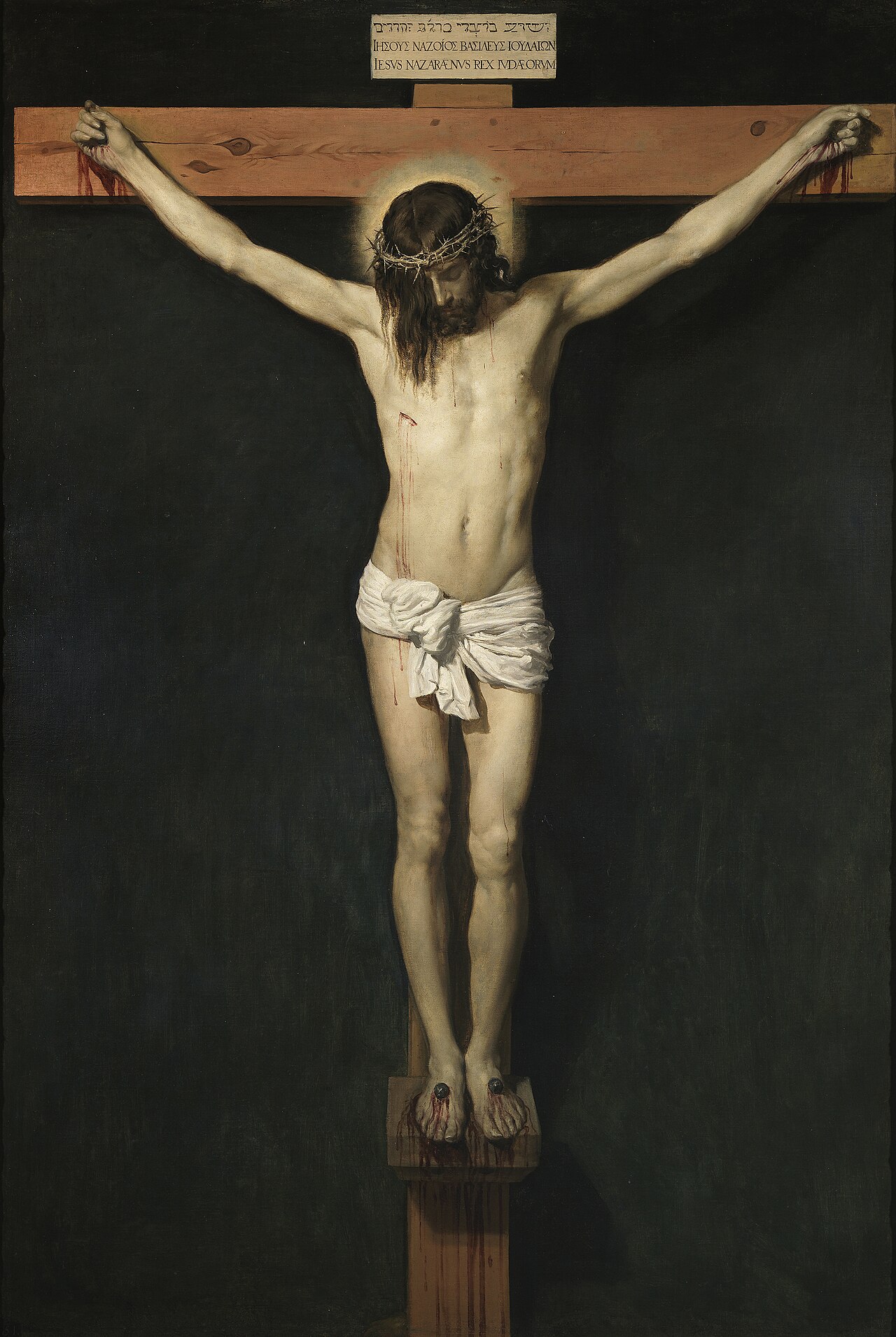
They crucify him at Golgotha, and Pilate has the last, stubborn word — a sign fixed above the cross, written in the three languages of the empire so no passerby could miss it.
The chief priests want it changed — "write instead, 'This man said, I am King'" — and Pilate, for once, refuses: "What I have written I have written." So over the dying Jesus, in the language of religion, of government, and of culture, a placard announces to the whole world exactly who he is. It was meant as a charge. It reads as a proclamation. Below it, the soldiers gamble for his clothing, and John notes it fulfills Psalm 22 to the letter — "they divided my garments among them, and for my clothing they cast lots." Even the small indignities were written down centuries before. And in the middle of his agony, Jesus attends to one last piece of family business:
He calls her "Woman" — the same word he used at Cana, at the first sign (2:4), now at the last hour — and with almost no breath to spare, he makes sure his mother will be cared for, entrusting her to the beloved disciple. Even here, even now, love attends to the person in front of him.
3“It is finished”
"I thirst" — the one who is himself the living water, thirsting, so that we might drink. And then the word that is the summit of the whole Gospel. In English it is three words; in Greek it is one.
τετέλεσταιtetelestai · "it is finished / accomplished / paid in full"
This is not the groan of a man whose life is finally over. It is the shout of a workman who has completed the job. The word was stamped on business documents and receipts to mean "paid in full" — the debt is settled, nothing remains owing. That is what Jesus declares from the cross. The rescue is not almost done, not begun and left for us to finish; it is accomplished. Every sin that would be laid on him has been laid on him; every price has been paid; the work the Father gave him to do is complete. And notice the very next words: he "bowed his head and gave up his spirit." He was not killed so much as he handed his life over — laying it down of his own accord, exactly as the Good Shepherd said he would (10:18). His last act is as sovereign as his first.
4Blood, water, and a secret disciple
To hasten death before the Sabbath, soldiers break the legs of the two men crucified with him. But when they come to Jesus, he is already dead, so instead one pierces his side, "and at once there came out blood and water" (19:34). John, an eyewitness, insists on this detail (19:35), and then tells us why it matters — two more Scriptures, fulfilled in the handling of a corpse.
"Not one of his bones will be broken" is the rule for the Passover lamb (Exodus 12:46). So John closes the circle he opened on page one, when the Baptist pointed and said, "Behold, the Lamb of God" (1:29). Here is the Lamb, dying at Passover, his bones unbroken like the lamb whose blood kept death away. The gospel that began with a pointing finger ends with a pierced side.
John insists the cross fulfilled Scripture in detail. Read the passages he is pointing to as Jesus dies:
Then two frightened men find their courage at last. Joseph of Arimathea, "a disciple of Jesus, but secretly for fear of the Jews," asks Pilate for the body. And with him comes a name we have been waiting on since chapter 3.
Nicodemus, the ruler who first crept to Jesus under cover of darkness (3:1–2), now steps into broad daylight to bury him, hauling an extravagant, kingly weight of spices, his secret allegiance blown for good. The man who came by night has finally come to the light. John does not comment; he just lays the detail down, and lets us feel the long, slow conversion completed at a tomb. They wrap the body and lay it in a new tomb in a garden. And there, for one dark Sabbath, the Word made flesh lies still.
Where this leaves us
Finished
Everything in this Gospel has been leaning toward one word, and now it has been spoken: tetelestai, it is finished. Not he is finished — the work is finished. The seed of wheat has fallen into the ground (12:24); the Lamb of God has taken away the sin of the world (1:29); the Son has been lifted up to draw all people to himself (12:32). And it is done, paid in full, with nothing left for us to add to it. That is the peculiar rest at the heart of the Christian faith: our acceptance with God does not hang on finishing something ourselves, because the one thing that needed finishing has been finished by another, and he said so with his dying breath. The King has been enthroned on his cross, the Passover Lamb has been slain with his bones unbroken, and even the timid have come to the light to honor him. All that remains is the garden tomb, and the morning that is coming.
Questions
- Every mockery of Jesus' kingship turned out to be true. Where do you see the world still unwittingly testifying to who Jesus is? Discuss
- "We have no king but Caesar." What lesser "kings" are you tempted to crown in order to keep Jesus at a distance? Reflect
- "It is finished" means paid in full. How does it change your daily life to believe there is nothing left for you to add to the work of the cross? Reflect
- Nicodemus came by night in chapter 3 and buries Jesus in daylight in chapter 19. Whose slow journey into the light does his story give you hope for? Discuss
- John, an eyewitness, stakes his testimony on the blood and water from Jesus' side. Why does it matter that the death of Jesus is presented as sober fact, not myth? Discuss