John ended the last chapter with a warning: crowds "believed" because of the signs, but Jesus "knew what was in man" and would not entrust himself to that kind of faith (2:23–25). Now, without a paragraph break in the Greek, he shows us one such man by name. Nicodemus is everything an Israelite could hope to be — a Pharisee, a ruler, a teacher of the nation — and he has been impressed by the signs. He comes with a compliment ready. And Jesus, who sees straight to the bottom of him, cuts the small talk off at the knees and tells him he must be born all over again.
1“You must be born again”
"By night." John never wastes a detail, and in a Gospel that has just spent a whole Prologue on light and darkness, a man arriving in the dark is not merely a note about his schedule. Maybe Nicodemus came at night for safety, unwilling to be seen with this controversial teacher. Maybe he wanted an unhurried conversation. But John wants us to feel it symbolically too: here is a man of the dark edging toward the light, not yet willing to step fully into it. That image matters, because the whole chapter comes back to it, and so, much later, does Nicodemus himself.
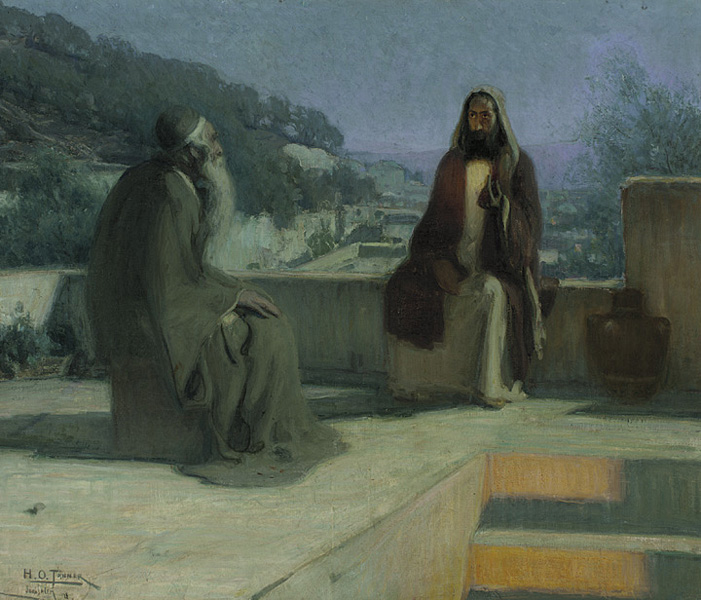
It is a strange reply to a compliment. Nicodemus never asked a question; Jesus answers the one underneath the flattery. You have come admiring my signs, he says in effect, but you cannot even see the kingdom of God from where you stand. You need something far more drastic than a new teacher. You need a new birth. And the word he chooses is a small hinge with two meanings on it.
ἄνωθενanōthen · "again" — or "from above"
The word Jesus uses can mean "again," a second time, and it can mean "from above." He intends both, and the double meaning is the whole point. Nicodemus hears only the first — "how can a man be born when he is old?" — and pictures the impossible absurdity of re-entering the womb. He is not wrong that it is impossible; he is only wrong about who does it. This birth is not something you organize a second time. It comes down, "from above," from God. John uses the same word later for Jesus who comes "from above" (3:31), and for the robe woven "from top" to bottom (19:23). To be born anōthen is to be given a life that originates in heaven, not in you.
"Born of water and the Spirit" would not have been a riddle to a teacher of Israel, and Jesus says as much a moment later, almost exasperated: "Are you the teacher of Israel and yet you do not understand these things?" (3:10). Nicodemus should have recognized the language, because it comes straight out of Ezekiel, where God promises the great renewal of the last days: "I will sprinkle clean water on you… And I will give you a new heart, and a new spirit I will put within you" (Ezekiel 36:25–26). Water for cleansing, Spirit for new life. Jesus is telling this expert in the Scriptures that the renewal his own prophets promised is now on offer, and that he needs it as badly as any pagan.
Then the image of the wind. In both Hebrew and Greek the word for "wind" is the same as the word for "Spirit" (pneuma), and Jesus plays on it. You cannot see the wind, cannot command it, cannot trace where it starts or stops — you only hear it and watch what it moves. So it is with the new birth. It is not a technique you master; it is a sovereign work of God, as free and uncontrollable as weather. That is humbling for a man like Nicodemus, whose whole life has been built on mastering the rules. The one thing he most needs is the one thing he cannot arrange.
The "new birth" is the New Testament's language for something the prophets had promised long before — a cleansing and a new heart worked by God's own Spirit. Trace the promise and its fulfillment:
2Lifted up — the serpent and the love of God
Nicodemus is still stuck on "how can these things be?" So Jesus reaches for a picture from Israel's own wilderness story, one Nicodemus would have known since childhood, and turns it into a preview of the cross.
The story is in Numbers 21. Israel, dying of a plague of venomous snakes sent in judgment, is told to do something that makes no medical sense: Moses is to make a bronze serpent and lift it up on a pole, and anyone who simply looks at it in faith will live. No treatment, no antidote — just a look at the thing God has lifted up. Jesus takes that ancient scene and says: that was about me. The Son of Man must be "lifted up" too, and all who look to him will live. The verb is doing the same double work as "born again": to be "lifted up" means both to be raised on a cross and to be raised in glory. In John, the cross is not the opposite of Jesus' exaltation. The cross is the lifting up.
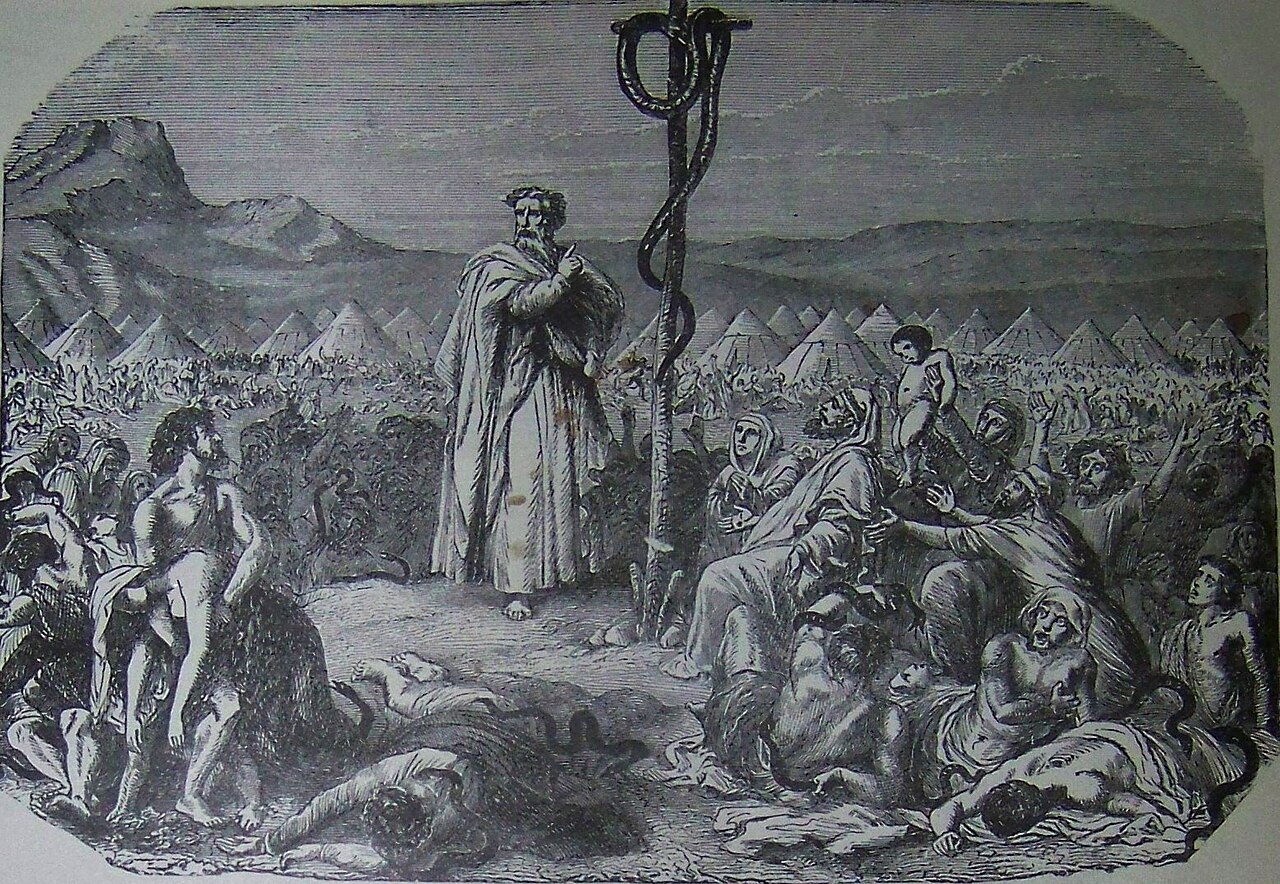
And then, still mid-sentence with a bewildered old rabbi in the dark, Jesus says the sentence much of the world can quote.
For God so loved the world, that he gave his only Son, that whoever believes in him should not perish but have eternal life.
John 3:16Familiarity has worn this verse smooth, so it is worth slowing down on the small word "so." We tend to hear it as so much — God loved the world so intensely. That is true, but it is not quite what the word says. The Greek houtōs means "in this way," "like this." God loved the world like this: he gave his only Son. The verse is not measuring the temperature of God's love so much as pointing at its shape. Look at the Son, lifted up like the serpent, and you are looking at exactly how God loved the world. And notice the object of that love: the world — kosmos, which in John almost always means the hostile, God-rejecting world. He did not love a world that deserved it. He loved the one that had turned on him, and he gave his Son to it, not to condemn it but to save it (3:17).
3Coming to the light
Here the chapter circles back to its opening image and turns it into a diagnosis of the whole human race. Judgment, John says, is not mainly a future courtroom scene; it is happening already, and it works by exposure. The light has come, and people sort themselves by how they respond to it. Those with something to hide flinch away and stay in the dark, not because the evidence is unclear but because they cannot bear to be seen. Those who are willing to be honest come toward the light, whatever it costs them. The verdict is not so much handed down as revealed by which way you walk. And there, quietly, sits the question hanging over the man in the shadows since verse 2: which way will Nicodemus walk?
John does not tell us how the night ends, and that is deliberate — he leaves Nicodemus, and us, mid-decision. But he has not finished with him. Nicodemus surfaces twice more: once cautiously defending Jesus' right to a fair hearing before his fellow rulers (7:50–51), and finally, astonishingly, stepping out of the shadows entirely to help bury Jesus' body in broad daylight, carrying seventy-five pounds of spices, his cover blown for good (19:39–42). The man who came by night ends up honoring the crucified Christ in the open. It seems the seed planted in the dark grew. John lets us watch a slow, real conversion across three scenes — a quiet encouragement to anyone whose coming to the light has been more of a long walk than a single leap.
The chapter closes with the Baptist stepping onstage one last time. His disciples are anxious that Jesus is drawing bigger crowds, and John the Baptist gives them the answer that is the summary of his whole life, and nearly of this whole chapter.
It is the last recorded word of the greatest man born of woman, and it is a glad stepping-aside. The friend of the bridegroom does not envy the bridegroom. He is thrilled to fade as the true light rises. Set the Baptist beside Nicodemus and the chapter's whole question plays out in two men. Both must decrease, must be born again from above, so that Christ can increase. One of them says it with joy. The other is still standing in the dark, deciding.
Where this leaves us
Something only God can do
The hardest and most freeing truth in this chapter is that the thing we most need is a thing we cannot do for ourselves. Nicodemus had spent a lifetime climbing — learning, keeping, teaching — and Jesus told him, kindly and without apology, that the ladder does not reach. You must be born again, and you can no more arrange your own second birth than you arranged your first. That is bad news to the self-made and wonderful news to the exhausted. Because if the new birth is God's work, blowing like a wind we cannot steer, then it is not finally about the strength of our grip but about the love of the God who "so loved the world that he gave." Our part is not to manufacture the wind. It is to stop hiding, to come out of the dark, and to look — the way the dying in the wilderness looked at the serpent on the pole — at the Son lifted up.
Questions
- Jesus tells the most religious man in the room that his goodness is not enough — he must be born again. Where are you tempted to trust your own record instead of the new birth only God can give? Reflect
- The new birth is like the wind: real, powerful, but not something we can command. How does it change your prayers for yourself or others to know this is God's work, not ours? Discuss
- "God loved the world like this — he gave his Son." How does reading John 3:16 as the shape of God's love, not just its intensity, deepen it for you? Discuss
- Judgment happens by which way we walk when the light comes on. Is there an area of your life you are keeping in the dark "lest it be exposed"? Reflect
- Nicodemus took years to come fully into the light. Whose slow journey toward Christ do you need the patience to keep praying for? Discuss